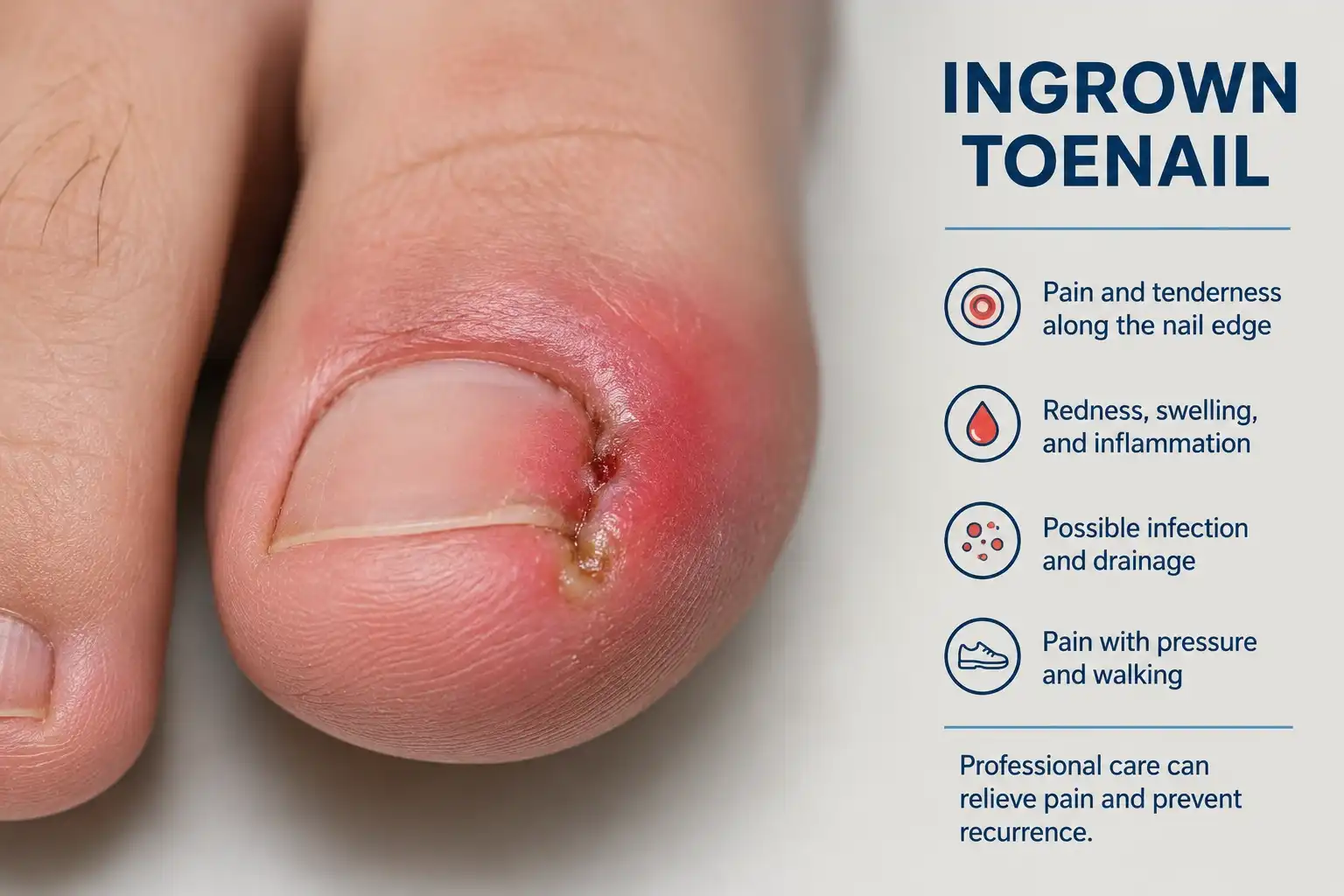
A complete patient guide to ingrown toenails, symptoms, causes, infection warning signs, treatment options, recovery, prevention, and when to schedule with a podiatrist.
Nail Pain & Swelling•Infection Warning Signs•In-Office Treatment
🦶 Patient Guide To Ingrown Toenails And Nail Pain
Patient Education Guide
Why Your Toenail Hurts, What It Means, And What Can Help
An ingrown toenail happens when the edge or corner of the nail grows into the skin instead of over it. That pressure can cause pain, swelling, redness, drainage, infection, and trouble wearing normal shoes. This page explains the condition in plain language so patients can understand what may be happening and when professional care makes sense.
🦶
Common Location
Ingrown toenails most often affect the big toe, usually along one nail border.
⚠️
Watch For Infection
Drainage, pus, warmth, spreading redness, or throbbing pain should be evaluated.
🩺
When To Call
Severe pain, recurring ingrown nails, diabetes, poor circulation, or numbness need podiatric care.
Complete Condition Guide
Patient Guide To Ingrown Toenails And Nail Pain
This guide covers what ingrown toenails are, what symptoms feel like, what causes them, how podiatrists diagnose them, treatment options, home care limits, recovery expectations, and local care at Jayhawk Foot & Ankle Clinic.
Overview
An ingrown toenail develops when the side or corner of the toenail presses into the surrounding skin. The result may be pain, tenderness, swelling, inflamed skin, bleeding, drainage, or infection. Ingrown toenails most often affect the big toe, but any toenail can become ingrown.
At first, the problem may feel like a sore spot near the nail edge. As pressure continues, the skin can swell around the nail and trap the nail edge deeper. That creates a frustrating cycle: the nail irritates the skin, the skin swells, and the swelling increases pressure against the nail.
Some mild ingrown toenails can calm down with early care. Others become painful, infected, or recurrent and need treatment from a podiatrist. Patients with diabetes, poor circulation, nerve damage, immune problems, or a history of foot wounds should not treat an ingrown toenail casually.
What Is An Ingrown Toenail?
A healthy toenail should grow forward over the skin at the end of the toe. An ingrown toenail forms when part of the nail edge grows into or presses against the skin along the nail fold.
The medical term for an ingrown toenail is onychocryptosis. The condition may involve one side of the nail, both sides of the nail, or the end corner of the nail. Once the nail border breaks or irritates the skin, bacteria can enter and infection can develop.
The problem is not always caused by one bad nail trim. Nail shape, shoe pressure, toe trauma, sweaty feet, fungal nail changes, sports, work boots, and inherited foot structure can all contribute.
Toenail pain, swelling, or drainage? Schedule an appointment before the nail edge digs deeper or infection becomes harder to calm down.
Symptoms may start small and then build as the nail continues irritating the skin.
Pain along one or both sides of the toenail.
Tenderness when the toe is touched or squeezed.
Redness or skin darkening near the nail edge.
Swelling around the nail border.
Skin growing over the side or corner of the nail.
Hard or irritated skin near the sore area.
Pain when wearing shoes, walking, running, or standing.
Bleeding near the nail fold.
Fluid, pus, or cloudy drainage if infection develops.
Throbbing pain when inflammation or infection worsens.
The toe may hurt only with pressure at first. Later, pain can become constant enough to interfere with shoes, sleep, sports, work, or daily walking.
Signs The Toenail May Be Infected
An ingrown toenail may be infected when the skin is no longer just sore or irritated. Infection warning signs include:
Pus or cloudy drainage.
Increasing redness, swelling, or warmth.
Throbbing pain.
Bleeding or raw tissue near the nail.
A bad smell from the toe.
Redness spreading beyond the nail fold.
Fever or feeling ill, especially with spreading infection.
An infected ingrown toenail should be evaluated. Antibiotics may be needed in some cases, but antibiotics alone may not fix the problem if the nail edge is still embedded in the skin.
What Causes Ingrown Toenails?
Ingrown toenails usually develop when the nail edge and surrounding skin are forced against each other repeatedly. Common causes and contributors include:
Cutting toenails too short.
Rounding or tapering the corners of the nail.
Tearing, picking, or digging at the nail edge.
Tight shoes, narrow toe boxes, tight socks, or tights.
Work boots or athletic shoes that crowd the toes.
Toe trauma, such as stubbing the toe or being stepped on.
Running, kicking sports, court sports, or repeated toe impact.
Sweaty feet that soften the skin around the nail.
Naturally curved, thick, wide, or fan-shaped toenails.
Fungal nail infections that thicken or distort the nail.
Poor foot hygiene or chronic moisture around the toes.
Inherited nail shape or toe structure.
Improper trimming is a major trigger. When the nail is cut too short or the corners are rounded, the nail edge may grow forward into the skin instead of over it. Shoe pressure can then force the nail deeper into the nail fold.
Who Is More Likely To Get Ingrown Toenails?
Anyone can get an ingrown toenail, but some patients are more likely to develop them.
Teenagers and young adults, especially with sweaty feet.
Athletes, runners, dancers, and patients in kicking sports.
People who wear tight shoes, narrow footwear, or protective boots.
People whose work keeps them on their feet for long hours.
People with curved, thick, brittle, or fungal toenails.
People who have trouble safely trimming their nails.
Patients with diabetes, poor circulation, nerve damage, or immune problems.
Older adults, because nails may thicken and become harder to trim with age.
High-risk patients should treat nail pain as more than an annoyance. A small nail wound can become a larger skin or soft-tissue problem when circulation, sensation, or healing is impaired.
Mild, Moderate, And Severe Ingrown Toenails
Ingrown toenails are often described by severity. The exact wording may vary, but the pattern is useful for patients.
Mild: tenderness, pressure pain, slight redness, and early swelling along the nail border.
Moderate: increased pain, more swelling, drainage, infection signs, or skin starting to grow over the nail edge.
Severe: significant pain, chronic inflammation, recurring infection, bulky irritated tissue, or a nail edge deeply embedded in the skin.
Mild cases may respond to conservative care. Moderate, severe, infected, or recurring cases often need in-office treatment to remove the nail edge that keeps driving the problem.
When To See A Podiatrist
Schedule an appointment if:
Pain is severe or worsening.
The toe is draining pus, fluid, or blood.
Redness, swelling, or warmth is spreading.
The toe is throbbing or difficult to touch.
The ingrown toenail keeps coming back.
You cannot wear normal shoes comfortably.
Home care is not helping.
The nail looks thickened, curved, distorted, or infected.
You have diabetes, poor circulation, nerve damage, numbness, immune problems, or a history of foot ulcers.
Do not wait on home care if you have diabetes or poor circulation and notice a foot sore, infection, drainage, or worsening redness. Those situations deserve prompt podiatric evaluation.
How Ingrown Toenails Are Diagnosed
A podiatrist can usually diagnose an ingrown toenail by examining the toe, nail edge, nail fold, skin, drainage, shoe pressure pattern, and medical history. Most cases do not require lab work or imaging.
Additional testing may be considered if infection is severe, drainage needs to be cultured, the nail looks unusual, trauma is involved, bone involvement is a concern, or the problem keeps returning despite treatment.
Stubborn or unusual cases deserve a careful look. Rarely, nail problems can be influenced by other issues such as a bony growth under the nail, a foreign body, inflammatory skin disease, or a nail-bed growth.
Ready to stop digging at it yourself? Book an appointment and get clear treatment for ingrown toenail pain, swelling, drainage, or recurring nail problems.
Treatment depends on the severity of the ingrown toenail, whether infection is present, whether the nail keeps coming back, and whether the patient has higher medical risk.
Conservative Treatment
For mild cases, treatment may include cleaning the nail border, reducing pressure, lifting or separating the nail edge when appropriate, padding, taping, changing shoes, improving nail trimming habits, and treating contributing moisture or fungal nail problems.
Partial Nail Removal
For painful, infected, or more advanced ingrown toenails, the podiatrist may numb the toe and remove only the ingrown portion of the nail. This is commonly a small strip along the side of the nail, not the entire toenail.
Matrix Treatment For Recurring Ingrown Toenails
If the same side keeps becoming ingrown, the podiatrist may recommend treating the nail root, called the matrix, along that border. The goal is to keep the problem edge from growing back and causing the same cycle again.
Infection Care
If infection is present, treatment may include drainage, removal of the nail edge causing the infection, wound care instructions, topical medication, or oral antibiotics when appropriate. The embedded nail edge usually has to be addressed for the infection to fully settle.
Need treatment, not just information? Learn about in-office ingrown nail treatment options, including temporary relief and permanent correction for recurring nail edges.
Mild ingrown toenails may improve with careful home care if there is no infection and no high-risk medical condition.
Soak the foot in warm water.
Keep the toe clean and dry between soaks.
Wear roomy shoes or open-toed shoes that do not press on the toe.
Avoid running, kicking, or tight footwear until irritation calms down.
Use a small amount of petroleum jelly or antibiotic ointment with a clean bandage if the skin is irritated.
Use over-the-counter pain medicine only if it is safe for you.
Some patient resources describe gently placing clean cotton or dental floss under the nail edge after soaking. That is not appropriate for every toe. Do not try it if the toe is infected, bleeding, severely painful, or if you have diabetes, poor circulation, numbness, or immune problems.
What Not To Do
Bathroom surgery is one of the easiest ways to make an ingrown toenail worse.
Do not cut a deep “V” into the nail.
Do not dig under the nail with sharp tools.
Do not try to cut out an infected nail edge yourself.
Do not pick, tear, or rip the nail corner.
Do not ignore pus, spreading redness, worsening pain, or warmth.
Do not keep wearing shoes that squeeze the toe.
Do not assume antibiotics alone will fix an embedded nail edge.
Digging at the nail may leave a sharp nail spike behind, create a deeper wound, or push bacteria into irritated tissue. If the toe is infected or recurrent, get it handled correctly.
Recovery After Ingrown Toenail Treatment
Recovery depends on the severity of the ingrown toenail and the treatment performed. Mild irritation may settle quickly once pressure is reduced. In-office nail procedures may require keeping the toe clean, covered, and protected while the skin heals.
Patients may be told to rest, elevate the foot, use roomy shoes, avoid painful activity, and follow wound care instructions. Swimming, hot tubs, tight shoes, and high-impact activity may need to wait until the toe is healing well.
If part of the nail is removed without treating the matrix, the nail may take months to grow back fully. If the matrix is treated on one side, that edge is intended not to regrow in the same way.
Preventing Ingrown Toenails From Coming Back
Prevention usually comes down to reducing pressure, trimming properly, and catching nail changes early.
Cut toenails straight across instead of rounding the corners.
Keep toenails even with the tips of the toes.
Avoid cutting nails too short.
Do not tear or pick at the nail edges.
Wear shoes with enough room in the toe box.
Avoid tight socks or tights that squeeze the toes.
Keep feet clean and dry.
Change sweaty socks and rotate shoes when needed.
Wear protective footwear when toe injury is possible.
Treat fungal toenails that become thick, brittle, or distorted.
Check feet daily if you have diabetes or reduced sensation.
See a podiatrist for routine nail care if you cannot safely trim your nails.
Recurring ingrown toenails are often a sign that the nail shape, shoe pressure, trimming pattern, or nail root needs professional attention.
Ingrown Toenail Treatment In Lenexa, Overland Park, Olathe, Shawnee, Leawood, And Kansas City
Jayhawk Foot & Ankle Clinic treats patients with ingrown toenails, nail pain, nail infections, and recurring nail problems in Lenexa, Overland Park, Olathe, Shawnee, Leawood, Kansas City, and surrounding Johnson County communities.
Patients choose Jayhawk Foot & Ankle Clinic for focused podiatric evaluation, practical treatment planning, and care from physicians who treat foot and ankle problems every day. If toenail pain is affecting your shoes, workday, sports, or ability to walk comfortably, it is worth getting a clear diagnosis.
Other Foot Problems That Can Overlap With Nail Pain
Toenail pain can overlap with infection, thickened nails, pressure sores, toe deformity, or diabetic foot concerns. These related condition pages can help patients understand nearby issues.
A very mild ingrown toenail may improve with early care, roomy shoes, and proper nail growth. If pain, swelling, drainage, or infection develops, it usually needs professional treatment.
Should I cut out my own ingrown toenail?
No. Cutting into the nail border at home can leave a sharp piece behind, create a wound, worsen infection, or make the nail grow back incorrectly.
How do I know if an ingrown toenail is infected?
Pus, cloudy drainage, warmth, spreading redness, swelling, throbbing pain, bleeding, odor, or fever can point to infection. An infected toe should be evaluated.
Do I need the whole toenail removed?
Usually, no. Many ingrown toenails can be treated by removing only the small nail edge causing the problem. Full nail removal is generally reserved for more severe or unusual cases.
Why does my ingrown toenail keep coming back?
Recurring ingrown toenails may be caused by nail shape, repeated pressure, poor trimming habits, tight shoes, fungal nail thickening, or incomplete correction of the problem nail edge.
Can kids and teenagers get ingrown toenails?
Yes. Ingrown toenails are common in adolescents and young adults, especially with sweaty feet, sports, tight shoes, trauma, or improper nail trimming.
Can shoes cause ingrown toenails?
Yes. Tight shoes, narrow toe boxes, tight socks, work boots, and athletic shoes that press the toes together can push the nail edge into the skin.
When should I schedule an appointment?
Schedule an appointment if pain is severe, drainage or pus is present, redness is spreading, the nail keeps coming back, or you have diabetes, poor circulation, nerve damage, or a history of foot wounds.
Insurance Accepted
Ready To Get Toenail Pain Checked?
Jayhawk Foot & Ankle Clinic evaluates ingrown toenails, toenail pain, nail infections, recurring nail problems, swelling, redness, drainage, and diabetic nail concerns for patients in Lenexa, Overland Park, Olathe, Shawnee, Leawood, Kansas City, and surrounding communities.